|
CycloBranch
|
|
CycloBranch
|
The window is opened by a double-click on a row in the output report if a branched peptide was identified. The Enter key can also be used if the row is selected.
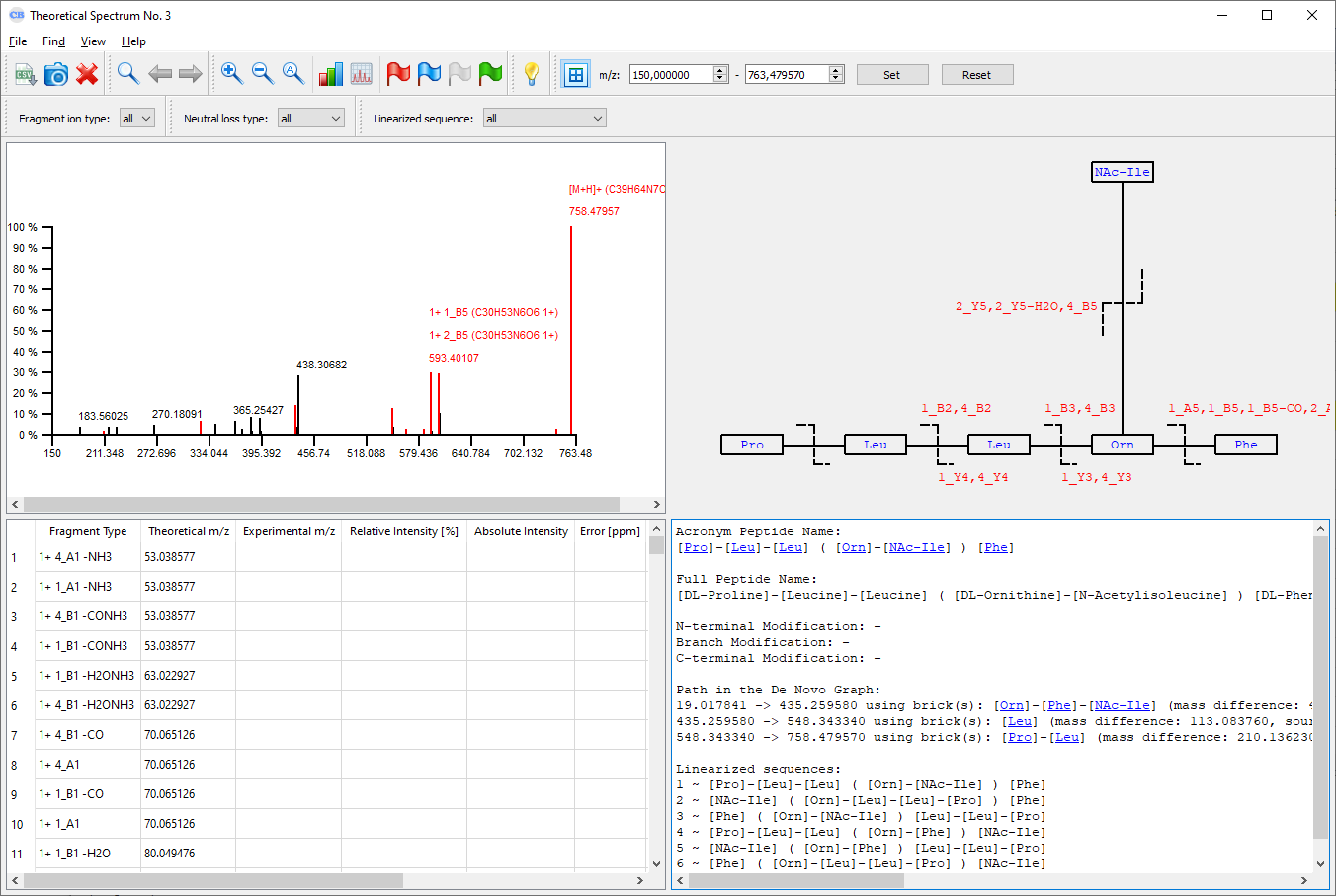
See also Linear Peptide Detail Window. The differences for branched peptides are following:
Numbers of linearized sequences of a branched peptide sequence are defined as follows (with respect to the visualization of a branched peptide):
The start point of a linearized sequence corresponds to a theoretical N-terminus. The end point corresponds to a theoretical C-terminus.
See also Toolbar for Linear Peptides. The differences for branched peptides are following:
Linearized sequence
A dropdown menu is shown where you can choose which peaks are red in the spectrum of the left and which fragment ions are shown in the visualization of a branched peptide on the right. You can choose that only theoretical peaks from one linearized sequence (e.g., 2) are red if they were matched with experimental peaks. In this case, the visualization of the peptide on the right shows only matched fragment ions from the linearized sequence 2. The default value "all" means that all matched theoretical peaks are red in the spectrum on the left and that all matched fragment ions are shown in the visualization of the peptide on the right.
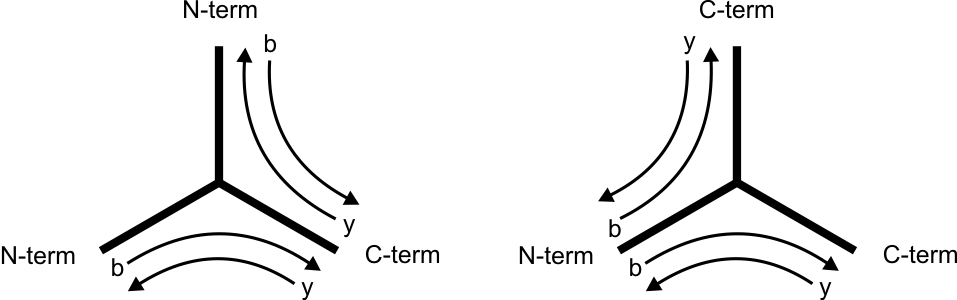
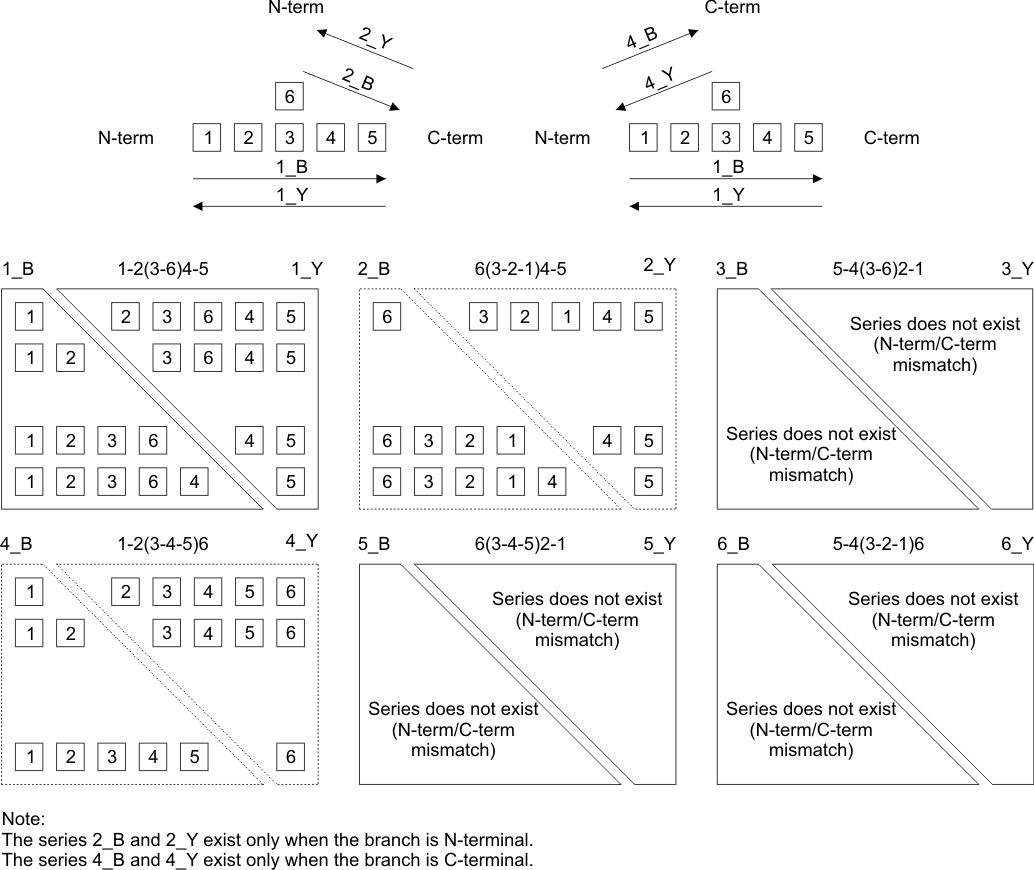
Series of fragment ions of a branched peptide are shown in the following picture.
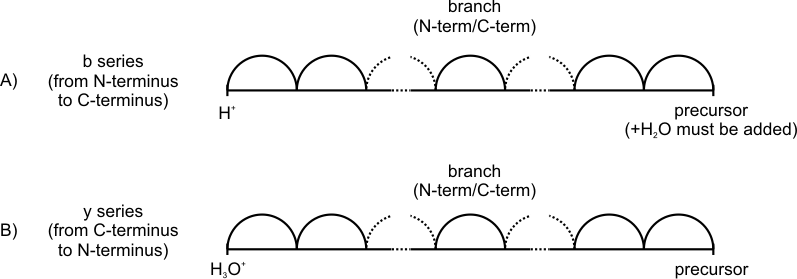
A path in the de novo graph corresponding to a branched peptide is detected as is shown in the following scheme (an edge corresponds to a residue mass of a building block or a sum of residue masses of a combination of building blocks). An edge corresponding to the branch must include at least two building blocks (one block cannot form a branch).
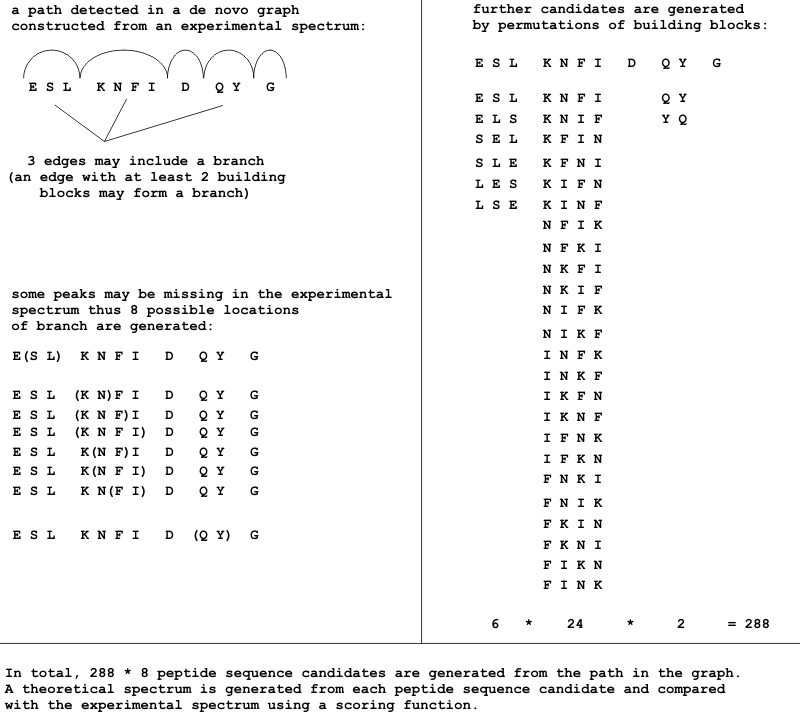
Since peaks determining the begin and the end of a branch may be missing in an experimental spectrum, the algorithm generates a set of peptide sequence candidates from a path in the graph instead of one sequence candidate. See the following scheme.
In the following picture, you can see a general scheme of a fragmentation of a singly branched peptide. A sequence of a branched peptide can be written by six different ways (called linearized sequences of a branched peptide sequence). Two series of ions can be generated from each linearized sequence (N-terminal and C-terminal), thus we get series of fragment ions 1B to 6B and 1Y to 6Y. However, the series 3B, 5B and 6B are unsense because N-terminal fragments cannot be generated from a C-terminal side. Similarly, the series 3Y, 5Y and 6Y are unsense because C-terminal fragments cannot be generated from an N-terminal side. The series 2B and 2Y exist only when the branch is N-terminal. The series 4B and 4Y exist only when the branch is C-terminal. Thus for a branched peptide, only four series of fragment ions can be observed in total - two series of b-ions (N-terminal ions) and two series of y-ions (C-terminal ions).
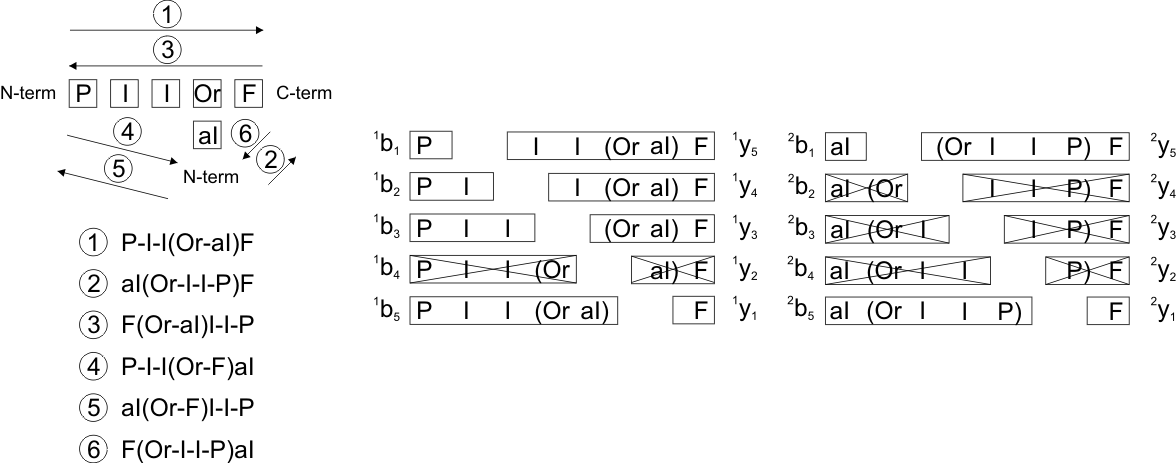
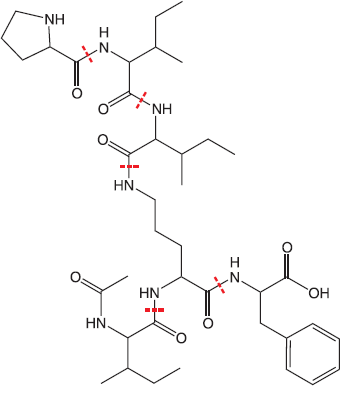
A scheme of theoretical fragments generated from a linearized pseudacyclin A is shown in the following picture. We assume that a ion of a branched peptide is fragmented only once and that the branch is not fragmented, thus some b-ions and y-ions do not exist in the theoretical spectrum (struck out in the following picture). If a branch was split, the ion would be fragmented for second time.
CycloBranch supports the identification of desferri- and ferri-forms of branched siderophores which are nonribosomal peptides. For details, see Linear Nonribosomal Peptide Siderophores.
 1.9.4
1.9.4 
